
Here’s a tree-planting guide for individuals, families, schools, homeschoolers, and community organizations with a brief history of Arbor Day and Earth Day.
Learning how to plant a tree for Arbor Day or Earth Day is a fun, educational DIY gardening project and an environmental activity idea for kids and adults of all ages. The public is encouraged to plant and care for trees annually on Arbor Day in April. Because Earth Day also falls in April and focuses on environmental improvement, planting a tree on that Day makes just as much sense. But of course, any day is a great day to plant a tree! Trees are necessary for much of what we know and love about life on Earth.
Use this step-by-step tree-planting tutorial and the gardening tips throughout this informative guide to plant trees for Earth Day, Arbor Day, or any day of the year. The tree planting instructions below make it easy to plant a tree with your kids, students, family, friends, school, workplace, or community. First published in April 2016, this DIY tree-planting gardening tutorial is regularly updated and republished to improve the content. You might also enjoy Care for Earth: 12 Ways to Reduce Climate Change.

Planting a Tree for Arbor Day or Earth Day:
Planting trees today makes tomorrow greener and brighter. Use the step-by-step DIY tree-planting tutorial below to plant a tree for Arbor Day, Earth Day, or any day! Before starting this DIY gardening project, I recommend reading through the tutorial so you know the steps involved and what to expect before actually planting a tree.
Whether you’re a seasoned environmentalist or a budding green thumb, this tree-planting guide is your ticket to positively impacting our planet one beautiful green sapling at a time. But before we dive into the nitty-gritty of digging holes and getting your hands dirty, let’s take a moment to appreciate why tree planting is not just a feel-good activity but an essential one for all beings on Earth. You might also enjoy these Earth Day Activities and Crafts.
How do trees benefit the environment and assist all beings on Earth?
Trees are the unsung heroes of our ecosystem, working tirelessly to keep our planet healthy and thriving. They purify the air we breathe and provide habitat for countless species, which is crucial in maintaining Planet Earth’s biodiversity and ecological balance. Fortunately, the benefits of tree planting extend beyond the natural world.
Trees are nature’s air conditioners, cooling our homes and streets and reducing the urban heat island effect. They also combat climate change by absorbing carbon dioxide, the main culprit behind global warming, and releasing oxygen into the atmosphere. So, planting trees isn’t just about beautifying our surroundings. It’s about growing a brighter, greener future and a better tomorrow for future generations–literally! Learn how to plant trees with the beginning tree gardening guide in the next section. You might also enjoy learning how to Plant Flowers organically.
Tree Planting Supplies:
- A young tree sapling from your local nursery.
- Choose a species appropriate for your local climate and soil conditions to ensure its growth and longevity.
 Gardening gloves.
- Shovel(s) and/or square garden spade.
- Hand cultivator.
- Fresh straw or mulch.
- Garden tarp (optional but recommended).
- Gopher basket (optional but recommended).
- This tree planting tutorial includes step-by-step DIY instructions for making a gopher basket.
- Gardening stake and tape (optional but recommended).
- Garden cart (optional).

 (s) and/or


 (optional but recommended).
Related: How to Sew a Button Apple Tree
How to Plant a Tree: Step-by-Step Tree Planting Gardening Tutorial:
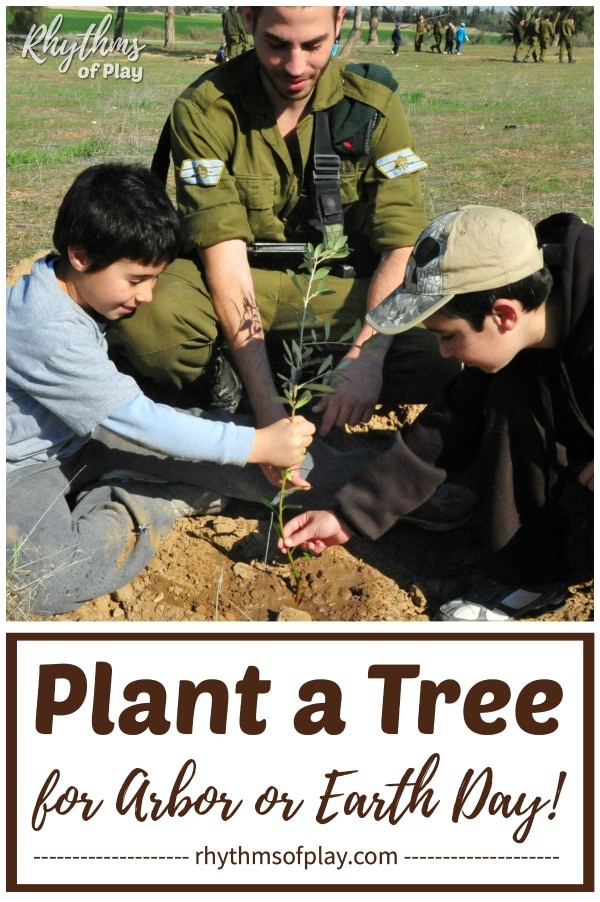
Follow the step-by-step instructions below to plant a tree. This post is part of the Get Outside & Connect Series. Click on the link to learn more about it. Scroll past the tree planting instructions for a brief Arbor Day and Earth Day history lesson.
1. Plant a young tree sapling:
- Plant a small young tree sapling, as opposed to an older tree.
- Older trees require much more work to plant than a sapling.
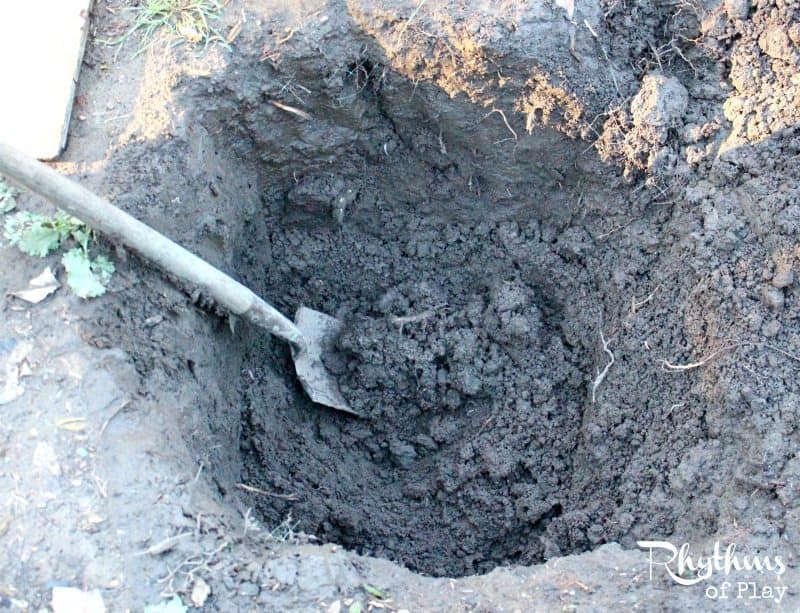
2. Dig a square hole for the tree:
- Lay a garden tarp on the ground next to where you plan to dig the tree’s hole.
- Place the soil on a garden tarp as you dig it out so that replacing the soil in the hole does not damage the surrounding area.
- Keep track of what soil was dug out first and what soil was dug out last.
- Dig a square hole rather than a round hole.
- When a tree is planted in a square hole, its roots will spread into the surrounding soil, whereas in a round hole they tend to circle and become root-bound.
- The only tree I know that benefits from becoming root-bound in a round hole is a fig tree, especially if you want it to stay small.
- The idea is to dig a hole approximately three to four times as wide as the container the tree or sapling came in.
Related: 15 Ways to Raise a Helper
3. Put a gopher basket in the hole that you dug out for the tree sapling (optional):
- Use a gopher basket to keep the gophers and other rodents from eating the roots and killing the young sapling or tree.
- As the tree grows and the roots no longer need as much protection, the wire will gradually rust away, no longer constraining the roots.
- My mom and I became experts at making DIY gopher baskets using four-foot poultry netting and galvanized wire.
- Follow the step-by-step directions below to make a DIY gopher basket:
 to keep the gophers and other rodents from eating the roots and killing the young sapling or tree.
  and
and How to Make a DIY Gopher Basket To Protect Young Tree Roots:
- Depending on the hole diameter, start by cutting a three- to eight-foot strip of chicken wire from the roll.
- Use wire cutters to snip several six to twelve-inch sections of galvanized wire.
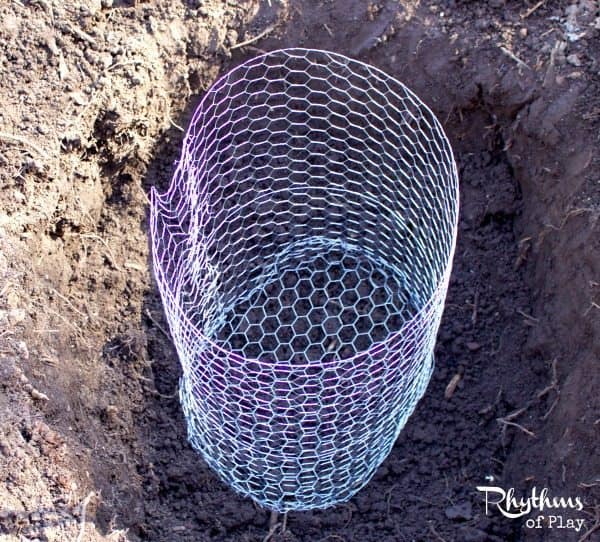
- Wrap these pieces of galvanized wire around each end of the chicken wire to connect the ends and form a cylindrical shape, as shown below.
- Use gloved hands to twist and weave the bendable metal any way you can to put the homemade wire gopher basket together.
- Ungloved hands can get cuts, pokes, and scrapes from wire bending.
- It doesn’t need to look good; it just needs to fit in the hole you dug, as shown in the photo below.
- Use gloved hands to twist and weave the bendable metal any way you can to put the homemade wire gopher basket together.
- Wrap these pieces of galvanized wire around each end of the chicken wire to connect the ends and form a cylindrical shape, as shown below.
- Cut another strip of chicken wire from the roll, about 1 to 2 feet long.
- Cut it again to create a square of chicken wire a bit larger than the diameter of the cylinder you made.
- Place the wire cylinder on top of the square of wire.
- Wrap the corners of the square around the cylinder, and once again, use gloved hands and sections of galvanized wire to weave or sew the wire gopher basket together.
4. Gently tease out the roots of the tree sapling before planting it in the ground:
- Use a hand cultivator to gently tease out the tree’s roots (as shown in the photographs below) after you remove it from the pot or container it came in before you plant it in the ground.
- Place the tree in the middle of the dug hole (with or without a gopher basket).
- Use your fingers or a hand cultivator to gently spread the roots apart before covering them with dirt.
 to gently tease out the tree’s roots (as shown in the photographs below) after you remove it from the pot or container it came in before you plant it in the ground.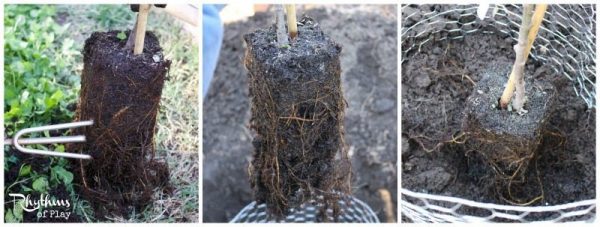
5. Fill in the hole around the tree sapling with soil:
- Place the young tree sapling and any stake (if it has one) into the hole, then hold it upright.
- Fill the hole around the tree sapling and gopher basket with soil in the same order you dug it out.
- In other words:
- Replace the dirt you dug out last, first.
- And the dirt you dug out first, last.
- The idea is to keep the topsoil on top and the subsoil on the bottom. It is not an exact science; do the best you can.
- In other words:
- Fill in the hole so the soil level rests below the root collar, but avoid planting the tree too deeply.
- Ensuring the soil level rests just above the root collar is usually sufficient.
- Use a shovel to fill and firmly pack the soil around the newly planted tree, leaving no air pockets.
6. Water the tree into its new home:
- Water the tree as you replace the soil, then pack it into the hole around the newly planted tree sapling.
- This will help the soil settle and eliminate air pockets as you fill it in.
- It’s best to water trees regularly the year they are first planted.
- Watering once every seven to ten days is usually enough.
- Keep the soil and mulch around your tree moist but not soggy.
7. Add a garden stake to help the tree grow upright:
- If the tree sapling has no garden stake to hold it upright as it grows, now is a good time to add one.
- Push a gardening stake into the ground next to the tree’s stem and secure the tree to it with gardening tape.
8. Put mulch around the tree to protect it:
- After the water has soaked in, it is also a good idea to spread mulch around the base of your new tree sapling to provide protection and warmth.
- We like to use straw from a local farmer for this purpose, but bark or wood chips also work well.
9. Consider putting a fence or tree guard around the sapling to protect it:
- I recommend placing a tree fence or guard around the young tree because deer, other animals, and pests could eat or damage the sapling’s leaves or bark.
- One way to do this is to make another chicken-wire protection basket over or around it, and use garden stakes, landscape stakes, or camping pegs to hold it down.
- Or purchase a tree guard or trunk protector to put around it.
Related: Four Season Handprint and Fingerprint Tree
Tree-Planting Gardening Tips:
- If the tree has a graft (many fruit trees do), ensure it rests just above the soil line and does not get covered when planted.
- Also, make sure that the graft does not face south.
- You don’t want the graft to be hit by the strongest sunlight for most of the day.
- Do not add soil amendments to the hole unless necessary.
- If the surrounding soil is too different from the soil you have amended, the tree’s roots may not want to grow out of it.
- In this case, the tree’s roots can become root-bound, just as they would in a pot.
- Water your tree regularly after you plant it in the ground.
- The soil and mulch around your tree should be moist but not soggy.
- Watering new trees once or twice weekly is usually enough for the first growing season.
- Remember, the tree does not have extensive roots at this time.
- Clean your garden tools right after you use them to prevent rust, and then put them away.
- Well-maintained tools last much longer and will save you money and hardship.
- Teaching children life skills, such as planting trees and maintaining gardening tools, will serve their learning and benefit them well into the future.
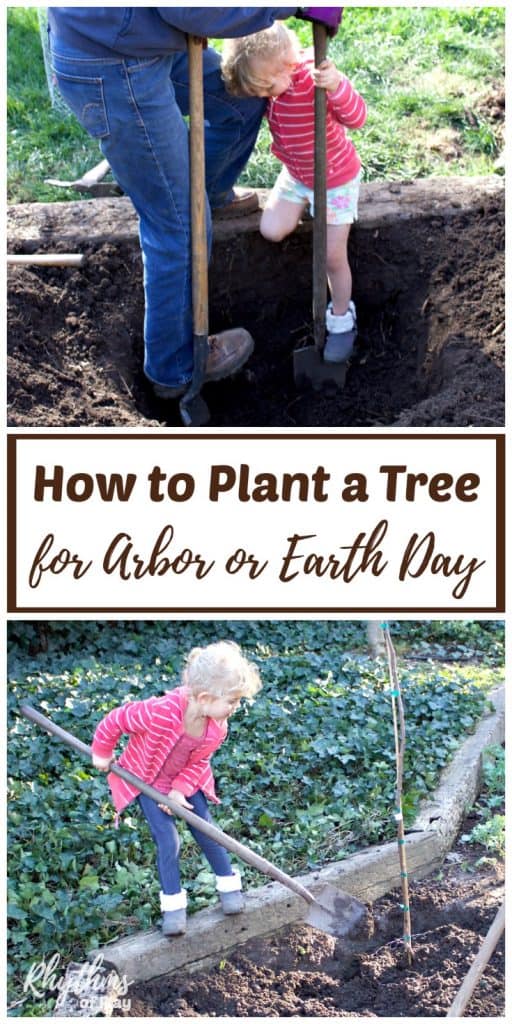
- In the photograph below, my late organic gardening expert mother (Carol Miller) demonstrates one way to help my daughter (a toddler who says “me-do” or “I try”) learn to dig a hole for a tree sapling in her backyard.
Arbor Day History Lesson:
In the US, Julius Sterling Morton began Arbor Day in Nebraska in 1872 to raise awareness of the importance of trees. Arbor Day reminds us of the vital role that trees play. They help maintain ecosystems, provide clean air and water, and mitigate climate change.
What is Arbor Day?
Arbor Day is a holiday dedicated to planting and caring for trees. It originated in the United States in the 19th century when J. Sterling Morton proposed setting aside a day for tree planting and increasing awareness of their importance. He believed trees were needed to serve as effective windbreaks and provide fuel and building materials, so Arbor Day was founded.
But Arbor Day is not just a day on the calendar to let pass like any other. It’s a day you can take action by planting, caring for, or educating yourself or others about the magic of trees. It’s a time for tree-planting events, donating to charities that support reforestation efforts (such as the Arbor Day Foundation), educational activities about the benefits of trees, and efforts to promote conservation and environmental stewardship in young and old alike.
The first Arbor Day was celebrated in Nebraska in 1872 and has since spread to many other states. On that first Arbor Day in the US, more than 1 million trees were planted in Nebraska. Since then, the public has been encouraged to plant and care for growing trees on Arbor Day. However, planting a tree on Earth Day would make just as much sense. In the US, these holidays usually fall within a week of each other.
When is Arbor Day?
Today, Arbor Day dates vary by region, state, or country, but many countries celebrate it in the spring when tree planting is most feasible.
National Arbor Day is observed and celebrated in the United States on the last Friday in April. For many, this means planting a tree or several trees anytime on the last weekend in April. However, each state may celebrate Arbor Day on a different date, based on its local climate and optimal tree-planting times.
In other countries, Arbor Day is celebrated on different dates. It’s always a good idea to check with local authorities or organizations to determine the specific date of Arbor Day in a particular region.
Earth Day History Lesson:
In 1970, Senator Gaylord Nelson from Wisconsin founded Earth Day. On April 22, 1970, he held an environmental teach-in because he was worried about the pace of industrialization and the lack of environmental care.
Since the advent of Earth Day, most people have forgotten about the importance of Arbor Day. May this post serve as a reminder of the importance of planting new trees, no matter which holiday you prefer to celebrate!
When is Earth Day?
Earth Day is April 22 in the United States.
Plant a Tree for Arbor Day or Earth Day!
Planting a tree is a fun and educational DIY gardening project for the whole family. Use these simple gardening and tree-planting tips to teach your kids how to plant a tree for Arbor Day or Earth Day this year.
But before you rush to find the perfect spot for your newfound green companion, let’s recap why tree planting is the ultimate eco-conscious gardening activity. Planting trees is like giving Mother Earth a big, leafy hug. Trees are the OG guardians of our planet, sucking up carbon dioxide like nature’s own vacuum cleaners and pumping out fresh, clean oxygen for us to breathe.
First, by planting trees, you are not just sprucing up the neighborhood but helping combat climate change and keep our air clean and crisp. Second, tree planting is a gift that keeps on giving. As your sapling grows into a mighty oak (or maple, or pine, you get the idea), it becomes a bustling hub of biodiversity, providing food and shelter for birds, bugs, and furry critters alike. Trees help prevent soil erosion, filter water, and even reduce noise pollution. Talk about multitasking!
Finally, planting trees is a surefire way to flex your green thumb and connect with nature. There’s something downright magical about watching a tiny seedling take root and grow into a towering giant, and knowing that you played a part in its journey is a feeling like no other. So go ahead, grab your shovel, and get ready to leave your mark on the world one tree at a time! Happy tree planting!
However, you can always hug one if you can’t plant a tree! You might also enjoy learning how to make a fairy garden or reading this list of Spring Activities. It includes a printable bucket list with seasonal arts, crafts, and fun spring activities for kids and adults. Or have a look at this massive list of outdoor activities for kids.
Learn more about Nell Regan Kartychok, author of this tree planting guide HERE, and more about Rhythms of Play HERE!
If You Liked How to Plant a Tree, You Might Also Enjoy:
- Growing Sunflowers with Kids
- Caring for the Earth: 12 Ways to Help Kids Live a Sustainable Life
- Encouraging Kindness to Nature
- Celebrate Earth Day Every Day
- How to Plant Organic Flowers
- Hug a Tree
- Composting at Home: What, Why, and How







Arbor Days are the best! It’s our favorite time of the year! We know it sounds ironic from someone like us but we’re in this business because we are passionate about trees. So excited for our Arbor Day this year! Stay safe!
We love planting trees 🙂